Showing posts with label rocks. Show all posts

Sunday, January 25, 2015

Lost Lake: Montana. Fields, Rocks, and Flowers.

Back in June, I took a trip out to Fort Benton, Montana for their annual summer celebration.  Located in North Central Montana, the landscape is seemingly flat with blue sky and green fields that seem to stretch all the way to the edge of the earth.  Rich in geological history however, the area has been carved and manipulated over time by powerful transformations of volcanic activity, the movements of the meandering Missouri River, and the formation and recession of glacial ice during the Ice Age.


One of the events at summer celebration included a talk at the Fort Benton Interpretive Center which helped me to understand the complex landscape that I was looking at, while allowing me to see the marks made over time by the Earth's tumultuous past.  I was excited to have the opportunity to visit the Loma, Montana Earth Science Museum, where I took a private tour of an impressive collection of minerals.  These two trips energized my already enthusiastic, yet amateur geological mind.  


For a day trip, I was taken on a tour of the surrounding landscape, en route to Lost Lake.  Located in the Shonkin Sag, Lost Lake sits approximately 250 feet below the surface of the ground, and is surrounded by exotic rock formations that stick out of the otherwise rolling, grassy landscape.  The site carries the imprint of the receding glacial ice during the Ice Age, where water collected in the Sag and flowed over the edge of the enormous cliffs and then poured into Lost Lake, creating magnificent waterfalls.

We received special permission to access the site, as Lost Lake is located on privately owned land.
Driving up the long dirt road, I was full of anticipation.  I wasn't sure what I might see, but was thrilled by the landscape, the sky, and the view of the mountains in the distance. 


Strangely shaped rock formations began to transform into ancient figures that appeared as if in conversation with one another.  The entire site was mysterious, emitting an ancient, and primitive air.  I began to feel as if I had somehow been transported back in time, or had suddenly entered a scene from Jurassic Park or Planet of the Apes.

The power of the earth and rocks to be able to silently speak of time and history, amazes me, making me feel as if I am connected to them on a level that I often have no words for.  It is something ancient, unknown, yet familiar at the same time, and here at Lost Lake they were speaking volumes.

We made our way carefully (and avoided stepping on any hidden rattlesnakes) towards the edge of the lake.  As we walked through the grass, weaving around the silhouetted stone figures I began to notice the variety of plants and flowers that were peeking out from between the rocks and grasses.


We approached the cliffs, surprised a few rabbits who were nestled in the shade of the rocks, and perched ourselves high above the breathtaking scene.


The panorama was stunning, completely isolated in the landscape while studded with only one visible farmhouse, and our parked truck far off in the distance.


I began to wind my way along the cliff's edge, investigating the eclectic variety of plant life growing high above the lake.  These plants were perhaps the only indication that time had not in fact stopped in this place, and that the cycle of their growth had continued throughout the centuries under the impenetrable gaze of these ancient geological formations.


I began to notice recognizable plants that were present in my own garden.  Here, where they grew wild among the rocks they were slightly different; miniature even, like the Monarda (Bee Balm), and blue Campanula pictured below.


I even noticed traces of Yarrow, and even a miniature type of Lupine.


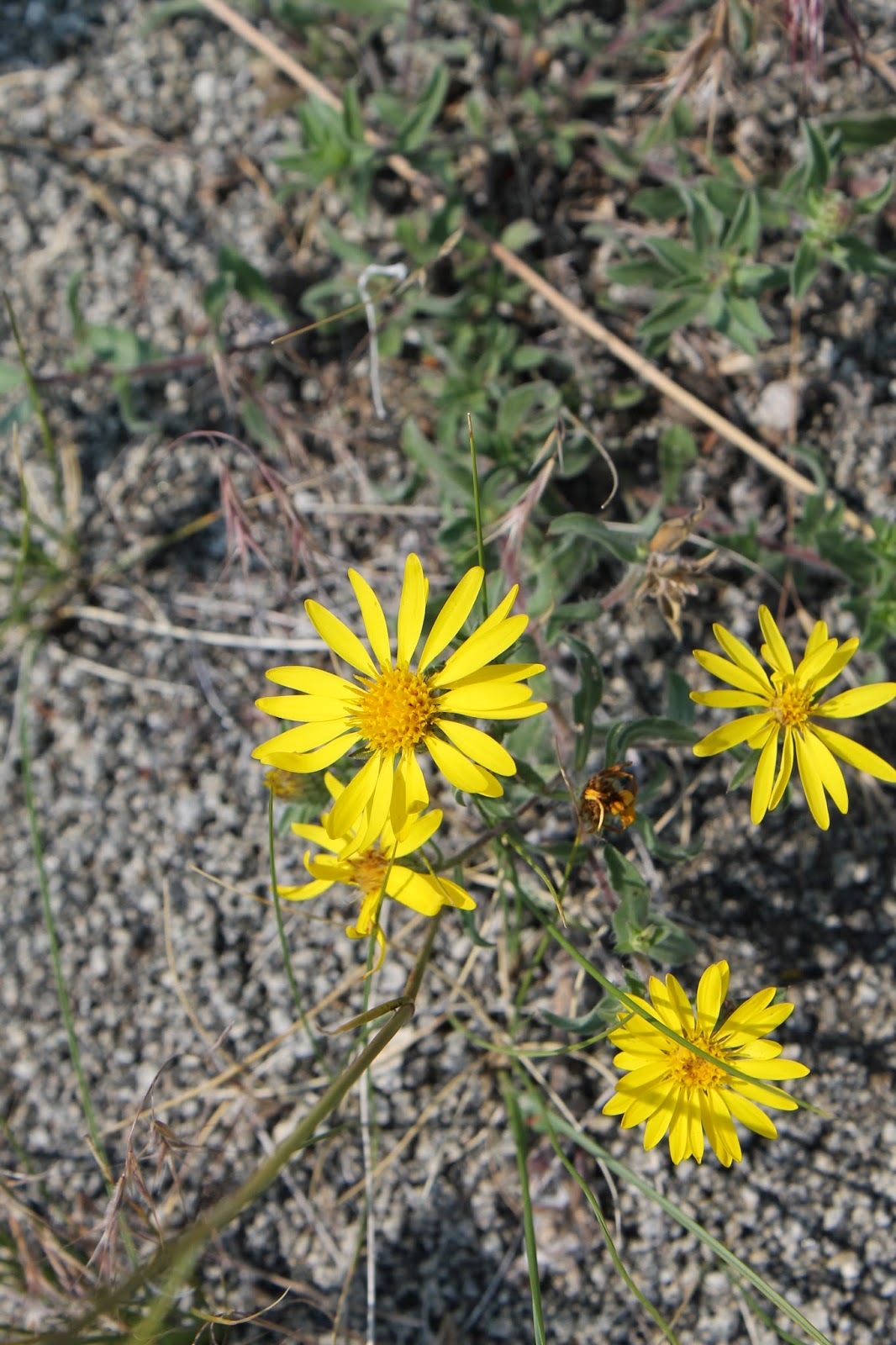
As I continued my exploration, I became more and more intrigued by the variety of wildflowers growing in this arid and extreme climate.


I was drawn in to the microcosmic world of lichens that resided on their rocky foundations, orange, mustard yellow, lime green, and sage colored, they began to look like little rock paintings.




After a few failed attempts at trying to tear myself away from this wondrous place, I managed to make my way, with cactus flowers lining the path, back to the truck.

We headed towards the Highwood Mountains, where the rocky terrain started to become green with trees, and fence lined farms with green rolling hills were speckled with grazing cattle.  The natural walls of stone that could be seen along the hills were evidence of prehistoric igneous intrusions, yet felt very much like the abandoned ruins of some ancient civilization.


We made our way to a hidden creek where I was able to set my feet on the wet rocks, and continue with my botanical explorations.  I spotted beautiful wildflowers and wild mint growing along the creek, in between the rocks. 


So then we made our way back, along the long seemingly infinite roads, under the vast sky, through  endless green wheat fields that shimmered and danced in the wind.


Note: I have discovered a wonderful article detailing the history and geology of Lost Lake and the Shonkin Sag area.  Please visit Last Best News for more information. 

Monday, February 24, 2014

Terrarium Time!

Is there anyone else out there who is itching to go outside, get your fingers in the soil, harvest fruits and veggies....?  Though it is not quite time for this yet, there are ways to get your hands (and dining room floor) dirty.  Terrariums are a great way to experiment and exercise your green thumb during the cold winter months allowing you to design a little indoor garden ecosystem of your own.

For the gardeners who aimlessly show up at garden centers looking for something green to tend to in the winter, many are now carrying a variety of terrarium supplies, plants, and containers.  I happened to be one of these aimless wanderers last week.

I became interested in terrarium gardening a few years ago when I visited the Philadelphia Flower Show.   Here I saw not only great little displays in all kinds of containers, but I also was introduced to the supplies and plants themselves.  I was so excited by the possibilities.


I bought a hanging terrarium and a few supplies that day along with some colored sand, glass pieces, and stones, and eagerly planted my own little world.

I visited Terrain the following summer and discovered,  a huge selection of jars, supplies, and small terrarium plants.  They had wonderful displays that made my mind race.  What kind of container?  What size?  Lid or no lid?  What kind of design?  What plants? The possibilities seemed endless!

Finally I chose a jar and some plants and brought them home.  Terrarium containers often range in price depending on size and complexity.  Some can be quite expensive so I have had fun looking for containers at garage sales and antique stores, hunting for unique shapes and styles!


So with my interest piqued and a few successful terrariums under my belt, this winter I decided to experiment with a few more of these mini gardens, to see what I could come up with.

Over the last year or so, I have collected both closed and open containers, have tried orchids, mosses, ferns, african violets, and succulents.  It is interesting to learn the environment in which particular plants will work, and those that will grow well together.  Some prefer closed, humid environments, while others enjoy some air circulation.

Here are a few examples of my experiments so far.


One of my favorite terrarium tools...the mister.


I have directly planted the plants in soil in some of my containers, where I have added a layer of stones or gravel for drainage.

In the closed cloche however, I left the plants in their pots arranging them in levels using small terracotta pots.  I like the variation in height and texture that this creates.  I rarely have to water these plants, as the humidity and moisture circulates throughout the jar.  To ensure that the container is not completely sealed, I added a layer of moss around the base.  The fern does so well in this particular environment that I need to cut it back every once in a while.

I have found that when leaving the plants in their pots, they should be kept in a closed container, as open ones tend to dry out a bit more.

Certain plants however, such as succulents, do not like to be kept in a closed, humid environment.  Paying attention to these requirements along with monitoring the plants will lead to a deeper understanding of their individual and group needs.  


In the terrarium below, I noticed that many plants were drying out too quickly.  I took a branch from a jade plant and planted it here, as jade plants do well in a drier climate.  I added some chartreuse moss for color, a little Japanese bridge and little figure of an old man to this miniature world.


The design of each container is part of what makes this process so enjoyable and exciting.  I have included rocks, shells, sea glass, and even geodes that I have collected over the years as landscape elements.  I find that this returns these collected treasures to the landscape and highlights them on a microcosmic scale. 


Most importantly when making your terrarium, use your imagination, experiment, and soon you will have a unique understanding of the little environment that you've created!